Ready for the Close-up: When Consolations Become Desolations in Sunset Boulevard
🎧 Prefer to listen? Click the audio below to listen to me narrate this post.
A few weeks ago, my graduate students and I watched Sunset Boulevard in my Career Discernment Workshop course.
I should say upfront: this is not a happy movie. It’s a 1950 film noir about a desperate screenwriter and a faded silent film star. Some people call it a drama. Others call it a horror film. There is no redemptive ending, no triumphant turn, and no catharsis that leaves you feeling good about humanity.
And it is one of the most instructive films about Ignatian discernment I have ever seen precisely because there is no happy ending.
<Side bar: If you want a quick and entertaining overview of the film, check out Jaymes Mansfield’s Free Film School Class episode of Sunset Boulevard [E].>

Sunset Boulevard street sign. Photo credit: @cedricletsch
Why This Film
My career discernment classes usually watch Soul, Barbie, The Golden Girls episode “How Do You Solve a Problem Like Sophia?”, or Sunset Boulevard. Each one illuminates different dimensions of Ignatian discernment without a single mention of God, the Jesuits, or the Spiritual Exercises.
Soul and Barbie are the easiest entry points. They get across messages core to Ignatian discernment while leaving audiences with hope. They show the journey of how consolations – what brings us increases in hope, trust, and love – can initially feel great but ultimately leave us empty. These films have redemptive endings because their characters eventually find their way.
Sunset Boulevard is not a redemption story. That’s exactly why my graduate students this semester were excited to watch it. In their own words, they loved grit. They wanted the moments of breakdown that reveal what a character is actually made of. So this semester, we watched Sunset Boulevard together.
Within minutes of our discussion, they named something that often gets glossed over in conversations about Ignatian discernment:
Not all consolations stay consolations. Sometimes we don’t always have the ability, experience, support, or willingness to face that uncomfortable, often unwanted, truth.
Two Sets of Rules for Discernment
To more fully understand this nuance, we need to look at Ignatius of Loyola’s two sets of rules for discernment, which are meant to help us track the movements in our inner life.
Broadly speaking, the first set is fairly intuitive: what leads toward greater love, freedom, and life is consolation; what leads toward isolation, distortion, and diminishment is desolation.
The second set is harder because they get at the complexity of our interior life. They also ask us to pay attention to what happens to our inner life over time.
Some of the trickiest spiritual movements don’t begin in desolation. They begin in consolation and slowly, almost imperceptibly, change direction. This is where Sunset Boulevard lives and why Norma Desmond is hands down my favorite character of all time.

Norma Desmond (Gloria Swanson) and Joe Gillis (William Holden) surrounded by photos of Norma.
Norma Desmond: A Case Study
If you’ve seen the film, you already know Norma Desmond (Gloria Swanson).
She is a once adored silent film star. She was revered, a central figure of Hollywood receiving thousands of fan letters every day. And this part matters: her early experiences of consolations were real.
She did matter.
She was beloved.
She was participating in something meaningful.
That’s what makes her story so precise and so unsettling.
The desolation doesn’t arrive all at once for Norma. It slowly drifted in, like it does for so many of us who experience burnout, fading dreams, and closed doors.
By the time we meet Norma, she is living in a mansion that feels less like a home and more like a mausoleum. The outside world has moved on. She has not.
But what’s striking is not just that she’s out of touch with reality, at least not from what we see on the outside. She receives fan letters. She is working on a screenplay that she firmly believes will be directed by Cecil B. DeMille. She is preparing for her return — not a comeback, a return because, in her mind, she never left.
From the inside, her life has purpose, momentum, and even a kind of clarity.
From the outside, it is a sustained illusion.
And here is where Ignatian discernment comes in: desolation does not always feel like despair. Sometimes it feels like certainty.
Ignatius warns that consolations can become dangerous when we cling to them, when we stop holding them with openness and begin organizing our lives around preserving them.
That is Norma’s tragedy. Her identity as an artist becomes an identity she cannot release. Her past success becomes the only version of herself she can tolerate. Her longing to create becomes a need to be seen, admired, and restored. What was once life-giving becomes self-enclosed.
And because she cannot let go, she cannot grieve.
Because she cannot grieve, she cannot change.
Because she cannot change, she cannot return to reality.
This is desolation. Desolation doesn’t always leave us feeling empty, but it can subtly, sneakily lead us away from truth.
Why She Can’t See It
One of the most painful dimensions of the film is that Norma is not sustaining this illusion alone. Her tragedy is not one of her own making.
Max (Erich von Stroheim), who is her butler, her former husband, and the director who helped make her famous, has built an entire ecosystem around her that protects the illusion for both of them.
He writes the fan letters. He filters reality. He reinforces the narrative. He loves her. And that love has become enabling.
Ignatius would call this a failure of freedom, not just for Norma, but for everyone around her. There is no indifference here, no capacity to hold reality and illusion side by side and choose truth.
By the time aspiring writer, Joe Gillis (William Holden), arrives at the mansion and where we meet Norma for the first time, she is not simply choosing delusion. She has lost the ability to see outside of it, and this inability culminates in the film’s final scene.
Without spoiling too much: Norma descends her mansion’s grand staircase, bathed in the artificial glow of spotlights and cameras. Norma is fully convinced that the cameras are rolling for her long-awaited return in her original screenplay directed by Cecil B. DeMille. Only there is no DeMille in the mansion – there are only news crews, Max her enabler, and gossip columnist Hedda Hopper to witness Norma’s grand exit.
We watch as Joe Gillis narrates, “Life, which can be strangely merciful, had taken pity on Norma Desmond. The dream she had clung to so desperately had enfolded her.”
“All right, Mr. DeMille,” Norma says in the final words of the film, “I’m ready for my close-up.”
As the final scene fades, we know what Norma doesn’t. She is alone. She is disconnected from reality. She has mistaken performance for truth.
This is the quiet warning embedded in Ignatius’s second set of rules: If we do not remain attentive, we may not notice when what once gave us life has begun to take us away from it.
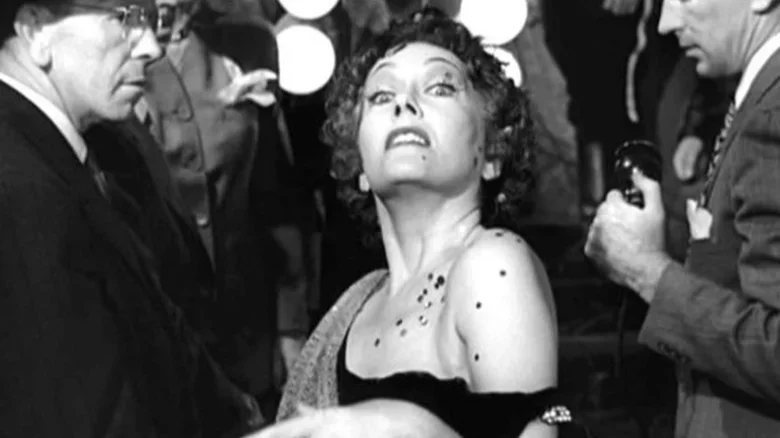
Norma’s iconic close-up.
Ready for Your Close-up?
I’d love to say that we are not Norma Desmond. But we are.
Most of us have held onto something longer than we should have:
A role that once fit but no longer does.
A version of ourselves that once felt true but has become constricting.
A consolation that we slowly reorganized our lives around protecting.
The question is not simply, “Does this feel good?”
The question is: “Where is this leading me? Toward greater freedom, honesty, and connection? Or toward something smaller, more controlled, and more fragile? Is the certainty I might be drawn to giving me a false sense of freedom?”
Ignatian discernment asks something difficult of us. We are not to reject consolation, but we must remain free in relation to it. To do that, we need to cultivate the kind of interior and relational life where we can be honest with ourselves.
The question Sunset Boulevard asks, and that Ignatian discernment presses us to answer, is not just, “How do I recognize when consolations become desolations?” It's also, “Who do I have around me who will tell me the truth?”
Joe tried to tell Norma the truth, but Max interfered, further plunging Norma into despair.
Ignatius built community into the discernment process for exactly this reason. The Examen, the daily practice of reviewing our interior movements, is partly a check on our own self-deception. But it works best in relationship with someone who knows us well enough to ask the questions we’re avoiding.
The work of discernment is not just interior. It is relational. It asks us to cultivate the kind of relationships where truth-telling is possible and where we can really receive the truth, as unwanted as it may be.